
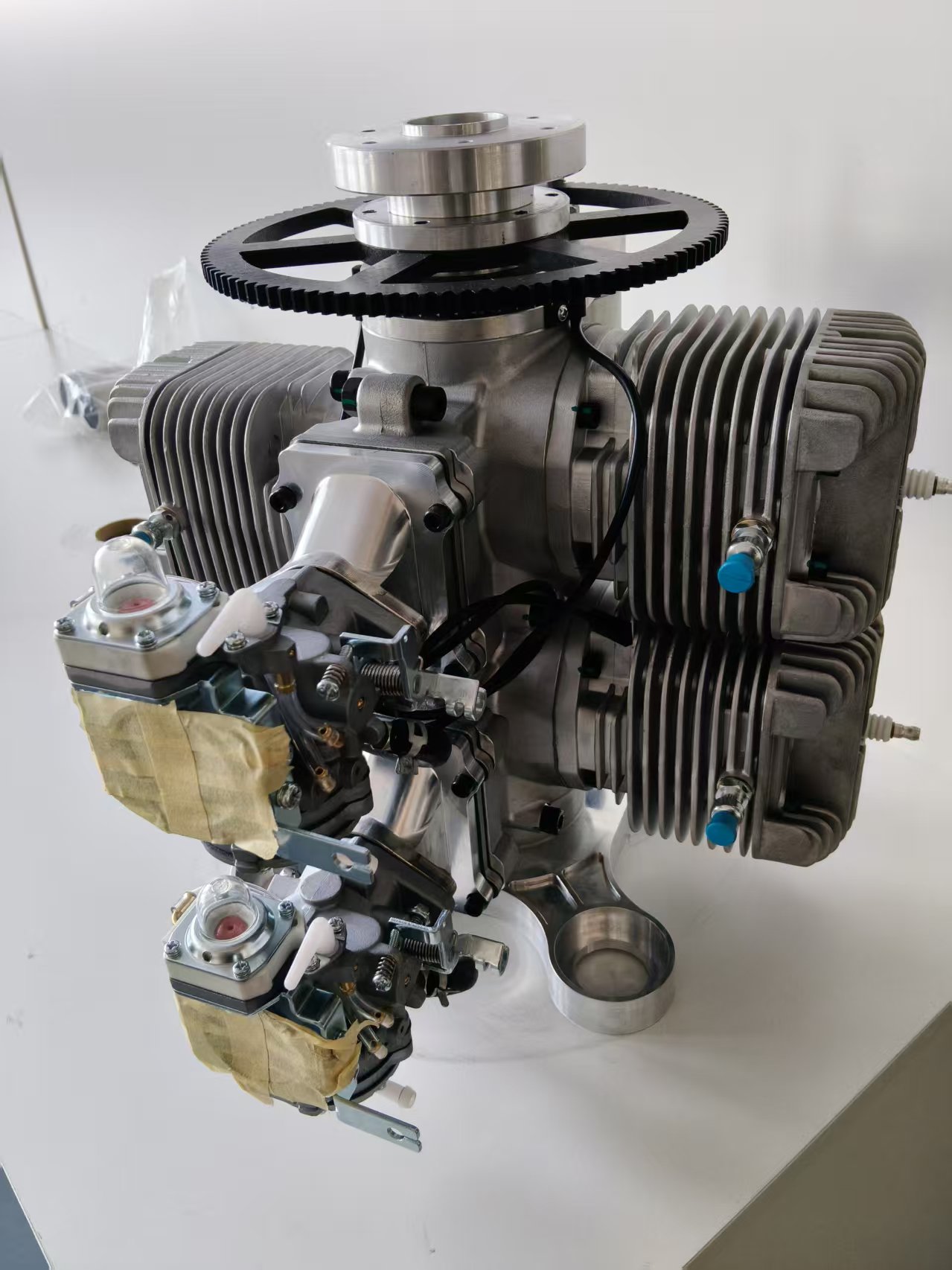
In the commercial and industrial drone sectors, flight endurance is the ultimate metric of capability. Whether conducting expansive agricultural surveys, monitoring miles of pipelines, or executing search and rescue operations, the longer a drone can stay airborne, the more valuable it becomes. To maximize drone flight time, engineers and operators consistently turn to the proven power of the 2-stroke UAV engine. Despite advances in battery technology, the 2-stroke gasoline engine remains the undisputed king of endurance for large-scale unmanned aerial vehicles.
The Challenge of Drone Flight Endurance
The primary obstacle to extended drone flight is weight. Every component, especially the power source, adds mass that the drone must expend energy to lift. Electric drones are trapped in a vicious cycle: to fly longer, they need bigger batteries, but bigger batteries add weight, which requires more power to lift, yielding diminishing returns on flight time.
A UAV petrol engine breaks this cycle through the sheer energy density of gasoline. A tank of fuel weighs significantly less than a battery pack of equivalent energy. More importantly, as the engine burns fuel, the drone becomes lighter, making it increasingly efficient as the flight progresses.
Understanding 2-Stroke Gasoline Engine Mechanics
Internal combustion engines generally fall into two categories: 4-stroke and 2-stroke. While 4-stroke engines are common in automobiles, the 2-stroke engine is uniquely suited for aviation.
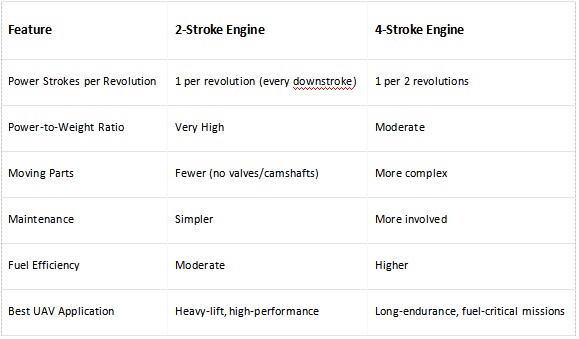
In a 4-stroke engine, the piston must complete four separate movements (intake, compression, combustion, exhaust) to generate one power stroke. A 2-stroke engine, however, combines these functions, producing a power stroke every single time the piston moves down. This means a 2-stroke engine fires twice as often as a 4-stroke engine running at the same RPM.
Why 2-Stroke Engines Dominate the UAV Market
The mechanics of the 2-stroke engine translate into several massive advantages for UAVs. First, the unmatched power-to-weight ratio: because they fire on every revolution and have fewer moving parts (no complex valve trains or camshafts), 2-stroke engines generate significantly more power per pound of engine weight than their 4-stroke counterparts. This high power-to-weight ratio is exactly what is needed to lift heavy drones and maximize payload capacity.
Second, simplicity and reliability: fewer moving parts mean there is less that can go wrong mid-flight. The simplicity of the 2-stroke design makes it inherently robust and easier to maintain, which is crucial for drones operating in remote or harsh environments.
Third, operational flexibility: 2-stroke engines can operate in any orientation, which is vital for drones that may experience steep banking or turbulence during flight.
2-Stroke vs. 4-Stroke UAV Engine Comparison
Highlighting ZT's Robust 2-Stroke Lineup
Shandong Zhongtian Technology (ZT) specializes in maximizing drone efficiency through its advanced lineup of 2-stroke gasoline engines. Their engines, ranging from 120cc to 730cc, are meticulously engineered to deliver the ultimate power-to-weight ratio.
For example, the ZT 350cc UAV Engine is a compact powerhouse that delivers exceptional performance for mid-sized heavy-lift drones. For larger applications, the ZT 630cc UAV Engine provides the immense thrust required to keep massive payloads airborne for hours, firmly establishing the 2-stroke engine as the premier choice for professional UAV propulsion.
Conclusion
When the mission demands hours of continuous operation, electric batteries simply cannot compete. By leveraging the high energy density of gasoline and the superior power-to-weight ratio of a 2-stroke UAV engine, operators can drastically maximize drone flight time. For reliable, long-endurance propulsion, 2-stroke gasoline engines remain the most effective and efficient solution in the sky.
RECENT NEWS
Leave A Message