
A UAV piston engine cannot be evaluated by displacement, maximum power and engine weight alone.
For fixed-wing UAVs, VTOL platforms and other unmanned aircraft, the engine works as part of a complete propulsion system. Engine output, propeller load, fuel supply, cooling, ignition, engine control and mounting structure must operate as one coordinated system.
For this reason, UAV engine ground testing is a critical part of propulsion-system validation before aircraft integration.
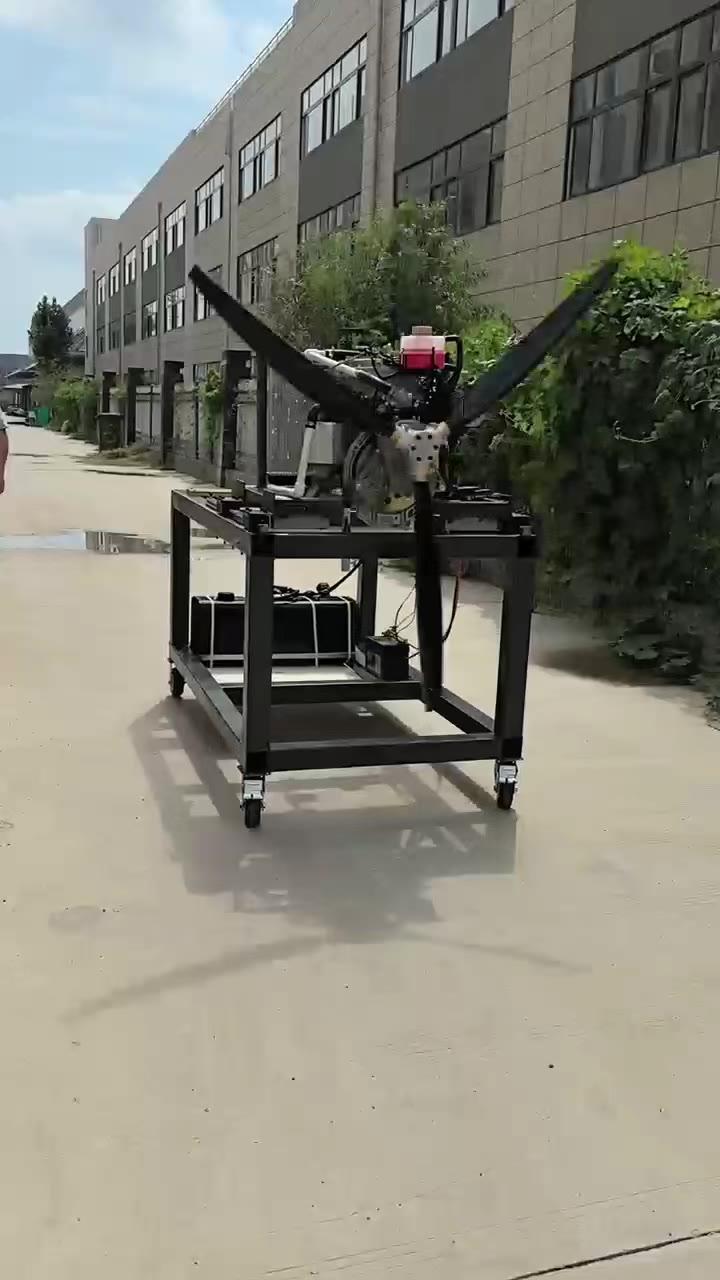
The SDZT test video shows a UAV piston engine mounted on a dedicated ground test stand and driving a large propeller under operating conditions. This test verifies the working condition of the engine-propeller system and provides direct technical evidence for propulsion-system evaluation.
What Is a UAV Piston Engine Ground Test?
A UAV piston engine ground test operates the complete propulsion assembly on a fixed test platform before installation on the aircraft.
A standard propulsion test system consists of the core components required for engine operation and measurement, including:
- UAV piston engine
- Propeller
- Engine mounting structure
- Fuel supply system
- Cooling system
- ECU and ignition system
- Starter and electrical system
- RPM measurement system
- Temperature monitoring system
- Propulsion performance measurement equipment
- Data acquisition system
The objective of the test is not simply to prove that the engine starts.
The test verifies whether the engine operates correctly under propeller load and whether the propulsion system meets the operating requirements of the target UAV platform.
For UAV manufacturers, system integrators and professional buyers, this is a much more meaningful evaluation than reviewing engine specifications alone.
What the SDZT UAV Engine Test Shows
In the SDZT test video, the piston engine is securely mounted on a ground test structure and directly connected to a multi-blade propeller.
The engine runs together with the actual propulsion load while technical personnel monitor the system.
This configuration allows the complete engine-propeller assembly to be evaluated under operating conditions.
A standalone engine and an engine driving a propeller are two different engineering conditions.
Once a propeller is installed, the engine must overcome aerodynamic resistance. Propeller diameter, pitch, blade number and rotational speed directly determine the load imposed on the engine.
This is why professional UAV propulsion development evaluates the engine and propeller as one propulsion system.
Key Technical Items Verified During UAV Engine Ground Testing
1. Engine Starting and Running Stability
Reliable starting and stable running are fundamental requirements for an unmanned aircraft engine.
The engine must:
- Start reliably
- Establish stable idle operation
- Respond correctly to throttle commands
- Accelerate smoothly
- Maintain stable RPM
- Return to idle without stalling
- Operate continuously throughout the required speed range
These characteristics are particularly important for unmanned aircraft.
Unlike a manned aircraft, a UAV relies on the flight-control and engine-control systems to manage propulsion during the mission. Stable and predictable engine response is therefore essential for reliable flight operation.
Ground testing verifies these operating characteristics before the propulsion system is installed on the aircraft.
2. Engine and Propeller Matching
Correct propeller matching is one of the most important elements of UAV piston engine integration.
An engine and propeller must operate within a matched RPM and load range.
Propeller selection directly affects:
- Engine RPM
- Static thrust
- Propeller load
- Acceleration
- Fuel consumption
- Engine temperature
- Cruise performance
- Take-off performance
The main propeller parameters include:
A propeller that places excessive load on the engine prevents the engine from reaching its correct operating RPM.
A propeller with insufficient load fails to use the engine's available power efficiently.
Professional UAV propulsion matching therefore starts with the engine operating range, aircraft requirement and propeller characteristics rather than selecting a propeller based on diameter alone.
3. Cooling-System Performance
Thermal management directly affects piston-engine reliability.
Combustion continuously generates heat in the cylinder, cylinder head, exhaust system and lubricated components. The cooling system must remove this heat and keep the engine within its designed operating temperature range.
During ground testing, engineers verify:
- Cylinder temperature
- Coolant temperature for liquid-cooled engines
- Cooling airflow
- Coolant circulation
- Radiator operation
- Pipe and hose connections
- Temperature stability during continuous operation
Correct thermal management becomes increasingly important during high-load and long-endurance UAV missions.
The aircraft installation must also provide sufficient cooling airflow around the engine and cooling components. Engine cowling, radiator position, airflow inlet and outlet design therefore form part of the propulsion-system integration.
4. Vibration and Engine Mounting
A piston engine generates cyclic vibration as a direct result of combustion, crankshaft rotation and reciprocating component movement.
For UAV applications, vibration control is critical because the aircraft contains vibration-sensitive systems such as:
- Flight controllers
- IMUs
- Navigation equipment
- Cameras
- Optical payloads
- Survey systems
- Communication equipment
- Electronic payloads
Ground testing allows engineers to inspect engine movement, mounting stability and vibration behavior while the engine is operating under propeller load.
The engine mount must provide sufficient structural strength while controlling the transmission of vibration into the airframe.
Correct engine mounting improves propulsion-system reliability and protects onboard electronics and mission payloads.
5. Fuel, Ignition and Engine Control
Stable combustion depends on accurate fuel delivery and ignition control.
A UAV piston engine propulsion system integrates:
- Fuel tank
- Fuel lines
- Fuel pump
- Fuel injection or fuel-metering system
- ECU
- Ignition system
- Spark plugs
- Electrical supply
- Engine sensors
For EFI engines, the ECU controls fuel delivery and ignition timing according to engine operating conditions.
During propulsion-system integration, engineers must confirm:
- Correct fuel type
- Fuel supply pressure
- Fuel flow capacity
- Fuel-line arrangement
- Electrical power requirement
- ECU connection
- Ignition-system operation
- Starting sequence
- Sensor operation
These requirements must be established during aircraft design because the propulsion system directly interfaces with the UAV's electrical, fuel and control architecture.
6. RPM and Propulsion Performance
Engine RPM is a fundamental parameter in UAV propulsion-system testing.
RPM shows whether the engine and propeller are operating at the intended working point.
A complete UAV propulsion test evaluates key performance data including:
- Engine RPM
- Static thrust
- Torque
- Engine power
- Fuel consumption
- Engine temperature
- Exhaust temperature
- Vibration
- Throttle response
- Continuous operating stability
These parameters provide the engineering basis for comparing propulsion configurations.
Performance data must always be associated with the corresponding test conditions, especially:
- Propeller diameter
- Propeller pitch
- Number of blades
- Engine RPM
- Fuel
- Test environment
For example, a static-thrust figure has engineering value only when the propeller configuration and operating RPM are known.
Professional UAV buyers should therefore evaluate complete test conditions rather than comparing isolated maximum values from specification sheets.
Why Propeller Testing Is Essential for UAV Piston Engines
An engine produces shaft power.
A propeller converts that shaft power into aerodynamic thrust.
The final propulsion performance therefore depends on the interaction between the two components.
The complete energy conversion process is:
Fuel → Engine Combustion → Crankshaft Power → Propeller Rotation → Aerodynamic Thrust
Every stage affects aircraft performance.
An engine with high rated power does not automatically produce a suitable UAV propulsion system. The engine must reach the correct operating RPM with the selected propeller while maintaining stable temperature, fuel delivery and mechanical operation.
This is why SDZT evaluates the engine together with the propeller instead of treating the engine as an isolated component.
Ground Testing Before UAV Integration
Ground testing establishes a controlled engineering environment for propulsion-system verification.
It allows direct inspection of the engine, propeller, mounting system, fuel system, electrical system and cooling system while the engine is running.
The engineering workflow follows a clear sequence:
Engine Selection → Propeller Matching → Ground Testing → Aircraft Integration → Flight Testing
Each stage solves a different engineering problem.
Ground Test
Ground testing verifies the propulsion system itself.
It focuses on:
- Engine operation
- Propeller matching
- RPM
- Thermal management
- Fuel supply
- Electrical operation
- Vibration
- Mechanical installation
- Propulsion performance
Aircraft Integration
Aircraft integration verifies the mechanical and system interfaces between the propulsion unit and UAV platform.
It includes:
- Installation space
- Engine mount
- Propeller clearance
- Fuel system
- Cooling airflow
- Electrical interface
- ECU communication
- Center of gravity
- Structural compatibility
Flight Test
Flight testing verifies the complete aircraft under actual aerodynamic conditions.
It evaluates:
- Take-off
- Climb
- Cruise
- Altitude performance
- Throttle response
- Fuel consumption
- Engine temperature
- Endurance
- Overall aircraft performance
A professional UAV propulsion-development process completes these stages systematically rather than relying on specification-sheet calculations alone.
How to Select the Correct UAV Piston Engine
Selecting a UAV engine starts with aircraft requirements.
Engine displacement alone is not a selection criterion.
The propulsion system must be matched to the complete UAV platform.
1. UAV Configuration
The engine supplier needs to know the aircraft configuration, including:
- Fixed-wing UAV
- VTOL fixed-wing UAV
- Helicopter UAV
- Heavy-lift UAV
- Special-purpose unmanned aircraft
Different aircraft configurations impose different propulsion requirements.
2. Maximum Take-Off Weight
MTOW — Maximum Take-Off Weight is one of the most important aircraft parameters.
It includes:
- Airframe
- Engine
- Fuel
- Payload
- Avionics
- Batteries
- Landing equipment
- Other onboard systems
MTOW provides the basic reference for propulsion sizing and aircraft-performance calculation.
3. Payload
Payload directly affects aircraft weight and mission requirements.
Professional UAV projects should specify:
- Payload weight
- Payload type
- Required electrical power
- Mission operating conditions
Examples include optical systems, radar, communication equipment, mapping systems and other mission payloads.
4. Operating Altitude
Operating altitude affects piston-engine performance because air density decreases as altitude increases.
The engine and fuel-control system must therefore be selected according to:
- Normal operating altitude
- Maximum operating altitude
- Mission profile
For high-altitude UAV applications, altitude performance must be considered from the beginning of propulsion-system selection.
5. Flight Endurance
Endurance determines the balance between engine performance, fuel efficiency, aircraft weight and fuel capacity.
Long-endurance UAVs require a propulsion system designed for stable continuous operation rather than maximum power alone.
The correct engine selection therefore considers both:
- Required take-off and climb power
- Continuous cruise operating condition
6. Propeller Installation Envelope
Aircraft design places clear limits on propeller size.
The supplier needs to understand:
- Maximum propeller diameter
- Available propeller clearance
- Pusher or tractor configuration
- Number of blades
- Installation position
These parameters directly influence engine-propeller matching.
7. Fuel Requirement
Fuel availability is an important factor for commercial and industrial UAV applications.
The propulsion system must be selected around the specified fuel and mission environment.
The required fuel type must therefore be confirmed during the engine-selection stage.
Information to Provide When Requesting a UAV Engine
Professional UAV buyers can speed up engine selection by providing complete project information in the first RFQ.
Send the following technical parameters:
This information allows the propulsion system to be selected according to the actual aircraft rather than from engine displacement alone.
What Professional Buyers Should Evaluate in a UAV Engine Supplier
For UAV manufacturers and system integrators, supplier evaluation extends beyond engine price.
A professional UAV engine supplier must support the complete propulsion-system integration process.
Complete Technical Specifications
The engine specification should clearly define:
- Engine type
- Displacement
- Power
- Weight
- Operating RPM
- Cooling method
- Fuel system
- Ignition system
- ECU
- Recommended propeller
- Dimensions
- Electrical requirements
Engine Testing Capability
Physical testing demonstrates that the supplier works with actual propulsion systems rather than relying only on theoretical specifications.
Ground testing provides direct verification of:
- Engine operation
- Propeller loading
- Starting
- Throttle response
- Thermal condition
- Mechanical stability
- Propulsion performance
Propulsion-System Matching
UAV buyers need more than an engine.
They need an engine that integrates correctly with the aircraft.
Technical support should therefore cover:
- Engine selection
- Propeller matching
- Installation
- Cooling
- Fuel supply
- ECU integration
- Electrical connections
- Operating requirements
Spare Parts and Maintenance Support
For serial production and long-term operation, spare-parts availability is an essential procurement factor.
The maintenance system must support critical engine components including:
- Spark plugs
- Ignition components
- Fuel-system components
- ECU-related components
- Seals
- Gaskets
- Sensors
- Service parts
Reliable parts supply reduces downtime and supports long-term fleet operation.
SDZT UAV Piston Engine Solutions
SDZT develops and supplies piston-engine solutions for professional unmanned aircraft applications.
Our UAV engine portfolio covers different displacement and power levels for various aircraft configurations and mission requirements.
Engine selection is based on the complete propulsion requirement, including:
- Aircraft configuration
- MTOW
- Payload
- Operating altitude
- Endurance
- Propeller
- Installation space
- Fuel requirement
- Electrical requirement
SDZT combines engine supply with propulsion-system technical support, helping UAV manufacturers and system integrators select and integrate the correct engine for their platform.
Our ground-testing process verifies actual engine operation with the propulsion system and provides a practical engineering basis for subsequent aircraft integration.
Frequently Asked Questions About UAV Engine Testing
What is a UAV piston engine ground test?
A UAV piston engine ground test operates the engine and propeller on a fixed test platform before aircraft installation. The test verifies engine operation, propeller matching, cooling, vibration and propulsion-system performance.
Why must a UAV engine be tested with a propeller?
The propeller is the actual aerodynamic load driven by the engine. Propeller diameter, pitch, blade number and RPM directly affect engine load and propulsion performance. Testing the engine and propeller together verifies the real working condition of the propulsion system.
What parameters are important during UAV engine testing?
The core test parameters are:
- RPM
- Thrust
- Torque
- Power
- Fuel consumption
- Engine temperature
- Vibration
- Throttle response
- Continuous running stability
Why is RPM important for propeller matching?
RPM shows whether the selected propeller places the correct load on the engine. An incorrectly matched propeller forces the engine outside its intended operating range and reduces propulsion efficiency.
What information is required to select a UAV piston engine?
Provide:
- UAV configuration
- MTOW
- Payload
- Operating altitude
- Required endurance
- Cruise speed
- Propeller requirements
- Fuel type
- Installation space
- Electrical requirements
These parameters define the correct propulsion-system configuration.
Is engine displacement enough to select a UAV engine?
No.
Displacement describes engine size but does not determine aircraft compatibility by itself.
Professional UAV engine selection requires evaluation of power, RPM, propeller load, aircraft weight, altitude, endurance, cooling, fuel system and installation conditions.
Discuss Your UAV Propulsion Project With SDZT
A reliable UAV propulsion system starts with correct engine selection, propeller matching and physical testing.
If you are developing a fixed-wing UAV, VTOL UAV, heavy-lift platform or other unmanned aircraft, send SDZT your technical requirements.
Please include:
- UAV type
- MTOW
- Payload
- Operating altitude
- Required endurance
- Cruise speed
- Propeller requirements
- Fuel type
- Installation space
- Required quantity
Our technical team will evaluate the aircraft requirements and recommend the appropriate UAV piston engine and propulsion configuration for your project.
RECENT NEWS
Leave A Message